Almost everyone has one specific book from childhood that refused to behave like the others.
It was not cheerful, it was not brightly instructional, and it did not feature smiling animals learning to share a tricycle. It had strange, crosshatched trees that seemed to grow out of the margins, shadowy hallways where the floorboards tilted, or a quiet creature sitting in the corner of the spread staring straight out of the paper at you.
You did not love it because it was comforting; you loved it because it felt real.
A great picture book does something a novel cannot: it makes the reader understand a sentence differently because of what is happening six inches away from it in the artwork. When an illustrator introduces shadow, deadpan humor, surreal melancholy, or the macabre into that relationship, the page ceases to be simple bedtime entertainment and becomes a profound work of visual literature.
THE SPECTRUM OF DARK WHIMSICAL ILLUSTRATION
Victorian Macabre & Crosshatch Ink
Edward Gorey · Tony DiTerlizzi · Gris Grimly
Fine-line gothic satire, Edwardian dread, and dry deadpan poetry.
Unruly Forests & Shadow Psychology
Maurice Sendak · Dave McKean · Neil Gaiman
Childhood emotional depth, textured mixed-media collage, and nocturnal creature wonder.
Charcoal Realism & Enigmatic Rooms
Chris Van Allsburg · Lemony Snicket
Hypnotic graphite rendering, unsolved architectural puzzles, and personified shadows.
Surreal Melancholy & Lost Treasures
Shaun Tan · Oliver Jeffers · Jon Klassen
Monumental industrial isolation, painted skies, and quiet deadpan humor.
For curious children, adult illustration collectors, and readers who treasure the physical beauty of the book arts, here are twenty landmark dark whimsical picture books and adjacent illustrated works across five thematic movements that prove imagination is at its finest when it is unafraid of the dark.
Movement I: The Victorian Macabre, Crosshatch Ink, and Peculiar Guests
In this territory, the ink is sharp as a raven’s claw. Drawing inspiration from Victorian funeral ephemera, Edwardian nursery rhymes, and silent cinema, these books turn etiquette and tragedy into exquisite, deadpan comedy.
The Gashlycrumb Tinies (1963)
Written and Illustrated by Edward Gorey
Edward Gorey’s most famous alphabet book is the undisputed crown jewel of macabre picture books. Beginning with “A is for Amy who fell down the stairs” and concluding with “Z is for Zillah who drank too much gin,” Gorey recounts the untimely ends of twenty-six Edwardian children.
What prevents the book from becoming grotesque is Gorey’s peerless artistic restraint. His obsessive, hair-thin crosshatching renders heavy wool coats, wallpaper damasks, and looming tombstones with museum-grade elegance. The comedy comes entirely from the gulf between the catastrophic events and the utter, unflappable nonchalance of the rhyming meter.
- The Page-Turn Mechanism: Each turn of the page reveals a single, stark tableau where disaster strikes with the quiet inevitability of a ticking mantle clock.
- Ideal Audience: Adult collectors, lovers of Gothic satire, and families with a healthy appreciation for gallows humor.
- Collector Edition: Explore The Gashlycrumb Tinies on Amazon
The Doubtful Guest (1957)
Written and Illustrated by Edward Gorey
On a wild, stormy night in a sprawling Victorian mansion, a solemn family encounters a peculiar, penguin-like creature wearing a long woolen scarf and yellow canvas sneakers standing atop an urn.
The creature moves inside, proceeds to tear whole chapters out of favorite books, sleep with its nose pressed against the bedroom wall, and stare into soup tureens. It offers no explanation and makes no sound. Gorey concludes with delicious understatement: “It came seventeen years ago: and it shows no intention whatever of going.”
- The Art of Character Design: The creature’s silent, unreadable silhouette: part bird, part anteater, part melancholic gentleman: is an iconic triumph of minimalist character design.
- Ideal Audience: Anyone who has ever felt like an awkward outsider or lived with an eccentric pet.
- Collector Edition: Explore The Doubtful Guest on Amazon
The Spider and the Fly (2002)
Written by Mary Howitt | Illustrated by Tony DiTerlizzi
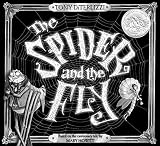
Illustrator Tony DiTerlizzi took Mary Howitt’s classic 1829 cautionary poem (“Will you walk into my parlour? said the Spider to the Fly”) and reimagined it as a dazzling 1920s silent horror film.
The Spider is a suave, pencil-mustachioed villain in a velvet smoking jacket, while the Fly is a wide-eyed flapper with gossamer wings. DiTerlizzi rendered the entire book in rich black, white, and shimmering metallic silver inks, packing the spider’s dilapidated Victorian parlor with cobwebbed chandeliers, antique gramophones, and the skeletal remains of former guests trapped under bell jars.
- The Word/Image Counterpoint: While Howitt’s verse warns of flattering words, DiTerlizzi’s artwork makes the parlor so visually opulent that the reader understands exactly why the fly walked inside.
- Ideal Audience: Children learning cautionary wisdom and collectors of cinematic gothic illustration.
- Collector Edition: Explore The Spider and the Fly on Amazon
The Melancholy Death of Oyster Boy and Other Stories (1997)
Written and Illustrated by Tim Burton
Before he directed modern cinematic classics, Tim Burton began as an animator and illustrator. This slender volume of illustrated poetry showcases Burton’s unique aesthetic at its most intimate, delicate, and melancholic.
Populated by unfortunate children: Oyster Boy, Stain Boy, the Girl with Many Eyes, and the Boy with Nails in His Eyes: each short piece reads like an absurd, heartbreaking modern nursery rhyme. Burton’s loose, scratchy ink drawings and pale watercolor washes give the characters an unmistakable vulnerability, proving that dark whimsy can be deeply sweet and profoundly sad in the same breath.
- The Power of Minimalist Verse: Short, rhythmic four-line stanzas paired with solitary character drawings on stark white paper.
- Ideal Audience: Adult art collectors, poetry lovers, and fans of Burton’s personal sketchbook art.
- Collector Edition: Explore Oyster Boy on Amazon
Movement II: Unruly Forests, Goblin Nights, and Childhood Dread
Childhood is not always a peaceful nursery. It is full of roaring tantrums, nocturnal shadows, and the sudden realization that parents cannot protect you from everything. These masterworks honor children’s emotional courage by showing them the wilderness.
Where the Wild Things Are (1963)
Written and Illustrated by Maurice Sendak
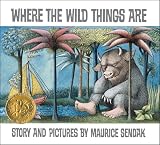
Maurice Sendak’s Caldecott-winning masterwork changed the landscape of children’s literature forever. When young Max is sent to bed without supper for wearing his wolf suit and making mischief, his bedroom walls transform into an ancient ocean and a primeval forest.
Sendak’s artistic genius lies in his dynamic layout design: as Max’s anger grows, the white margins around the pictures shrink page by page until the magnificent, three-spread “Wild Rumpus” bursts across the entire double page with zero text: pure, unadulterated visual noise. When Max smells good things to eat, the margins gently return, welcoming him home to a hot supper.
- The Masterclass in Book Arts: The physical expansion and contraction of white space as a direct visual metaphor for emotional regulation.
- Ideal Audience: Every human being who has ever felt angry, lonely, or wild.
- Collector Edition: Explore Where the Wild Things Are on Amazon
Outside Over There (1981)
Written and Illustrated by Maurice Sendak
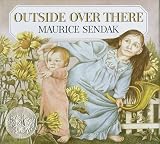
Sendak considered Outside Over There the third and deepest entry in his trilogy of childhood survival (alongside Wild Things and In the Night Kitchen). While her father is away at sea and her mother sits distracted in the gazebo, young Ida must care for her baby sister.
When hooded, faceless goblins creep through the window and replace the baby with a changeling sculpted out of melting river ice, Ida puts on her yellow wonder cloak and climbs backwards out of the window into the sky. Sendak’s lush, golden-toned paintings evoke German Romanticism, Renaissance drapery, and Mozart’s operas, creating an unforgettable portrait of sisterly bravery against dark folklore.
- The Emotional Depth: Sendak addresses the real, unspoken guilt and resentment an older sibling can feel, transformed into mythic rescue.
- Ideal Audience: Collectors of fine book illustration and readers of dark European folklore.
- Collector Edition: Explore Outside Over There on Amazon
The Wolves in the Walls (2003)
Written by Neil Gaiman | Illustrated by Dave McKean
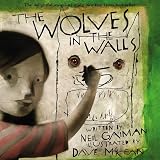
Lucy hears hustling, rustling, and crinkling noises inside the walls of her house. Her parents and brother dismiss her fears with the ominous household proverb: “If the wolves come out of the walls, it’s all over.”
Dave McKean’s revolutionary illustrations combine raw pencil sketches, paint splatters, scanned textures, and altered photographs of wooden puppets. When the wolves finally burst through the wallpaper to eat jam and watch television, the family escapes into the garden: until Lucy decides they should move inside the walls themselves.
- The Dynamic Mixed Media: McKean breaks down the traditional picture-book boundary, creating spreads that hum with acoustic vibration and kinetic anxiety.
- Ideal Audience: Kids who love spooky urban mysteries and adult graphic novel fans.
- Collector Edition: Explore The Wolves in the Walls on Amazon
The Three Robbers (1961)
Written and Illustrated by Tomi Ungerer

Alsatian illustrator Tomi Ungerer was a fearless master of visual design. In The Three Robbers, three terrifying highwaymen in tall black hats and flowing cloaks terrorize the countryside using a blunderbuss, a pepper-blower, and a great red axe.
One night, they ambush a carriage containing only a lonely orphan girl named Tiffany. When Tiffany asks what they plan to do with their mountain of stolen gold, the robbers realize they have never thought about it. They buy a castle and rescue every neglected orphan in the kingdom, turning their den of thieves into a vibrant city of red-roofed sanctuaries.
- The Graphic Power of Silhouette: Bold, jet-black robber silhouettes framed against saturated ultramarine blue night skies.
- Ideal Audience: Young readers discovering that scary appearances can hide unexpected kindness.
- Collector Edition: Explore The Three Robbers on Amazon
Movement III: Charcoal Realism, Quiet Mystery, and Unanswered Rooms
Sometimes the most eerie, enchanting picture books are not those that shout, but those that whisper. By using hyper-realistic charcoal shading and quiet architectural geometry, these creators make the impossible feel grounded in stone and wood.
The Mysteries of Harris Burdick (1984)
Created and Illustrated by Chris Van Allsburg
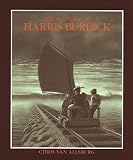
The Mysteries of Harris Burdick is one of the most brilliant concept books in publishing history. The framing story claims that a mysterious artist left fourteen finished drawings with a publisher, each accompanied only by a title and a single caption, promising to return with the complete stories the next day: and was never seen again.
From a nun floating serenely in an armchair inside a cathedral (“The Seven Chairs”) to two children watching a glowing ocean ship sail down a suburban carpet (“Under the Rug”), Van Allsburg’s velvety charcoal realism makes the impossible feel tangible. The book is an open invitation for the reader’s imagination to complete the universe.
- The Ultimate Reader Participation: A book that trusts the reader so completely that it leaves the narrative entirely unwritten.
- Ideal Audience: Writers, dreamers, classroom storytellers, and collectors of visual art.
- Collector Edition: Explore Harris Burdick on Amazon
The Garden of Abdul Gasazi (1979)
Written and Illustrated by Chris Van Allsburg
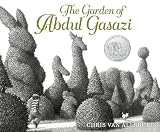
Van Allsburg’s debut picture book demonstrated an astonishing mastery of light, shadow, and architectural depth. Young Alan is walking a neighbor’s disobedient bull terrier named Fritz when the dog runs through the iron gates of Abdul Gasazi: a retired magician with a strict hatred for dogs.
Gasazi turns the dog into a duck: or does he? As Alan walks home in tears, the ending delivers one of the most delightfully ambiguous visual twists in modern picture books. Van Allsburg’s pencil work renders clipped yew hedges, stone statues, and long cast shadows with hypnotic precision.
- The Mastery of Monochromatic Light: Dramatic low-angle perspective and raking sunlight that feels like a quiet dream.
- Ideal Audience: Children who love gentle puzzles and lovers of classical draftsmanship.
- Collector Edition: Explore Abdul Gasazi on Amazon
The Dark (2013)
Written by Lemony Snicket | Illustrated by Jon Klassen
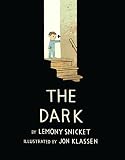
Laszlo is afraid of the dark. The dark lives in the basement of his big, creaky house, occasionally slipping into closets or corners, but mostly staying downstairs where it belongs. Until one night, the dark comes up to Laszlo’s bedroom and speaks: “Laszlo, I want to show you something.”
Lemony Snicket’s crisp, compassionate text and Jon Klassen’s gouache illustrations treat the dark not as an evil monster, but as a physical, necessary presence in the house. Klassen uses vast, flat fields of matte black ink contrasted against soft gouache wood tones to make the house feel immense, quiet, and ultimately safe.
- The Geometry of Comfort: The dark leads Laszlo to the bottom drawer of the basement dresser, giving him a spare light bulb so he never has to be afraid again.
- Ideal Audience: Young children confronting nighttime fears and fans of subtle modern illustration.
- Collector Edition: Explore The Dark on Amazon
The Little Wooden Robot and the Log Princess (2021)
Written and Illustrated by Tom Gauld

Cartoonist Tom Gauld brought his signature deadpan wit and clean graphic line art to this charming, modern fairy tale. A childless king and queen consult a royal inventor and a clever witch, receiving two children: a little wooden robot who must be rewound every night, and a log princess who turns back into an ordinary log whenever she falls asleep.
When a well-meaning maid accidentally tosses the sleeping log princess out the window, the little robot embarks on a quiet, perilous quest through goblin woods, passing the Queen of the Mushrooms and an Old Lady in a Bottle. Gauld’s delicate panel pacing and affectionate storytelling make this a modern classic.
- The Harmony of Whimsy and Craft: Clean crosshatching paired with warm pastel tones that feel like an illuminated storybook.
- Ideal Audience: All-ages readers seeking a fairytale with warmth, humor, and clockwork heart.
- Collector Edition: Explore Little Wooden Robot on Amazon
Movement IV: Surreal Melancholy, Gentle Monsters, and Lost Objects
Picture books are one of the few places in modern art where melancholy is permitted to be beautiful. In these books, sadness and loneliness are not problems to be instantly fixed; they are landscapes to be explored with wonder and gentle company.
The Red Tree (2001)
Written and Illustrated by Shaun Tan

Australian artist Shaun Tan created one of the most moving visual explorations of depression and emotional isolation in world literature. A young red-haired girl wakes up to find black leaves falling from her bedroom ceiling: “sometimes the day begins with nothing to look forward to.”
Tan’s monumental, surreal paintings depict the girl walking through hollow bottle cities, sitting in a tiny diving helmet inside a giant mechanical fish, and waiting on an abandoned theater stage. In every spread, Tan hides a tiny, glowing scarlet leaf: leading to an ending of overwhelming, quiet hope as a vibrant red tree blooms inside her bedroom.
- The Weight of Visual Metaphor: Rich oil impasto textures and industrial collages that give physical mass to inner emotional states.
- Ideal Audience: Teenagers, adult readers, art collectors, and anyone needing gentle comfort in difficult times.
- Collector Edition: Explore The Red Tree on Amazon
The Lost Thing (2000)
Written and Illustrated by Shaun Tan

While collecting bottle tops on a bleak, suburban beach, a quiet boy discovers a colossal creature that looks like a cross between a rusted boiler, a teapot, and a crab. Nobody else notices it; the city’s inhabitants are too absorbed in their commute and daily paperwork.
Tan painted the book on backgrounds made of discarded engineering textbooks, bottle labels, and physics diagrams, highlighting the cold, utilitarian logic of modern society. When the boy helps the creature find a secret, unmarked doorway in an alley, they discover a vibrant sanctuary filled with strange, unclassified, joyful beings.
- The Philosophy of Curiosity: A profound fable about preserving the capacity to notice weird and wonderful things in an indifferent world.
- Ideal Audience: All-ages readers, urban explorers, and lovers of retro-futuristic steampunk design.
- Collector Edition: Explore The Lost Thing on Amazon
The Heart and the Bottle (2010)
Written and Illustrated by Oliver Jeffers
A curious little girl loves exploring the stars and the ocean with an older mentor (implied to be her grandfather). When his favorite armchair is suddenly left empty, the grief is too heavy to bear, so she places her heart inside a thick glass bottle and wears it around her neck.
The bottle protects her from pain, but it also makes everything heavy, awkward, and dull. Years pass until she meets a young child who asks a question about the ocean, making her realize she needs her heart back. Jeffers’s loose, expressive charcoal lines and warm paint washes make this an extraordinarily tender book about love and recovery.
- The Simplicity of Shape: A heavy, glass bottle as an instantly legible symbol of emotional self-defense.
- Ideal Audience: Families experiencing loss and adult readers navigating bereavement.
- Collector Edition: Explore The Heart and the Bottle on Amazon
Du Iz Tak? (2016)
Written and Illustrated by Carson Ellis
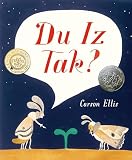
Caldecott Honor book Du Iz Tak? is a triumph of linguistic and visual imagination. Two dapper beetles in frock coats discover a tiny green shoot sprouting from the forest floor and utter the title question: “Du iz tak?” (“What is that?”).
Told entirely in an invented insect dialect that the reader deciphers effortlessly through visual context, the book follows the plant as it blooms, houses a caterpillar’s cocoon, gets invaded by a menacing spider, and withers under autumn snow. Carson Ellis’s delicate gouache botanical illustrations capture the miniature, mysterious drama happening right under our feet.
- The Joy of Cryptic Dialogue: Children and adults alike experience the thrill of decoding a foreign language through pure picture context.
- Ideal Audience: Curious children, botanists, linguists, and fans of whimsical naturalism.
- Collector Edition: Explore Du Iz Tak? on Amazon
Movement V: Deadpan Wit, Dark Folklore, and Morbid Laughter
This is the home of the straight face. When characters refuse to react with conventional sentimentality, the resulting comedy is sharper, stranger, and far more memorable.
The Skull: A Tyrolean Folktale (2023)
Adapted and Illustrated by Jon Klassen
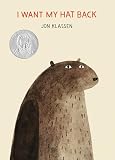
Jon Klassen discovered this strange Austrian folktale in an Alaskan library and adapted it into an unforgettable storybook. A young runaway girl named Otilla flees into the dark woods and finds an ancient, stone-walled house occupied by a rolling, talking skull who wears a crown of pears and loves drinking tea (which pours right through his jaw onto the floor).
The skull confesses his nightly terror: a headless skeleton climbs over the wall demanding the skull return to his neck. What follows is a pitch-black, hilarious, and fiercely empowering confrontation where Otilla defends her new friend with an iron fire poker.
- The Tone of Gentle Macabre: Warm domestic companionship inside a haunted alpine ruin, rendered in muted greys, ochres, and bone whites.
- Ideal Audience: Independent children, folklore lovers, and adult collectors of illustrated fables.
- Collector Edition: Explore The Skull on Amazon
This Is Not My Hat (2012)
Written and Illustrated by Jon Klassen
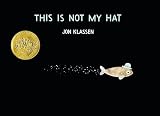
Winner of both the Caldecott Medal and the Kate Greenaway Medal, This Is Not My Hat is a masterclass in the unreliable narrator. A tiny fish wears a small blue bowler hat, swimming toward thick underwater plants while calmly explaining why he will never get caught: the big fish was sleeping, he probably won’t notice it’s gone, and even if he does, he won’t know who took it.
While the text expresses unshakeable confidence, Klassen’s illustrations tell the true, chilling story: the giant fish’s single black eye opens, his massive tail swishes, and he silently glides through the reeds. The final, quiet spread contains no text at all: only the big fish wearing the tiny hat.
- The Supreme Word/Image Contradiction: The comedy and tension exist entirely in the gap between what the narrator says and what the illustrations show.
- Ideal Audience: Readers of all ages who appreciate deadpan timing and crime-and-punishment humor.
- Collector Edition: Explore This Is Not My Hat on Amazon
Through the Woods (2014)
Written and Illustrated by Emily Carroll
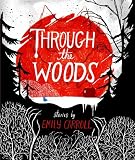
Bridging the world of the oversized picture book and the sequential graphic novel, Emily Carroll’s Eisner-winning Through the Woods collects five gothic horror stories that feel like unvarnished brothers Grimm folklore.
Carroll’s visual design is astonishing: pages dominated by suffocating black ink, punctuated by shocks of arterial red and glowing lantern yellow. In stories like “His Face All Red” and “A Lady’s Hands Are Cold,” the horror lies not in gore, but in psychological dread: the realization that the person standing in your kitchen is not who they claim to be.
- The Master of the Page Turn: Carroll uses text that trails across black gutters and around door frames, pulling the reader’s eye forward into darkness.
- Ideal Audience: Young adults, adults, and lovers of dark, atmospheric gothic graphic storytelling.
- Collector Edition: Explore Through the Woods on Amazon
Shrek! (1990)
Written and Illustrated by William Steig

Long before it was transformed into a computer-animated franchise, William Steig’s original Shrek! was a brilliant, eccentric, and fiercely literary picture book. Shrek is a green, wart-covered monster whose breath can cook an egg and whose presence makes flowers curl up in disgust.
Steig’s prose is a joyous feast of rich, eccentric vocabulary (“scathingly attractive,” “varlet,” “putrid”). When Shrek meets a princess whose nose is as crooked as a cabbage and whose face is as wart-covered as his own, they fall in love instantly and live horrifically ever after. Steig celebrates the grotesque with infectious, joyful warmth.
- The Celebration of Imperfection: A subversive, funny fable where being ugly and monstrous is an absolute delight.
- Ideal Audience: Children who love funny monsters and adults who appreciate brilliant literary wordplay.
- Collector Edition: Explore Shrek! on Amazon
Master Synthesis Matrix: The Dark Whimsical Picture Book Spectrum
| # | Title | Author / Illustrator | Year | Primary Medium | Comic / Emotional Mechanism | Core Aesthetic Category |
|---|---|---|---|---|---|---|
| 1 | The Gashlycrumb Tinies | Edward Gorey | 1963 | Pen & Crosshatch Ink | Deadpan alphabet of demise | Victorian Macabre Satire |
| 2 | The Doubtful Guest | Edward Gorey | 1957 | Ink & Gray Wash | Uninvited sneaker creature | Silent Edwardian Invasion |
| 3 | The Spider and the Fly | Mary Howitt & Tony DiTerlizzi | 2002 | Gouache & Silver Ink | 1920s flapper spider drama | Silent Cinema Gothic |
| 4 | Oyster Boy & Other Stories | Tim Burton | 1997 | Ink & Pale Watercolor | Misfit children tragedy verse | Fragile Tragicomic Poetry |
| 5 | Where the Wild Things Are | Maurice Sendak | 1963 | Tempera & Crosshatch | Margin expansion & wild rumpus | Primal Childhood Psychology |
| 6 | Outside Over There | Maurice Sendak | 1981 | Watercolor & Tempera | Ice baby changeling rescue | Romantic German Fairytale |
| 7 | The Wolves in the Walls | Neil Gaiman & Dave McKean | 2003 | Mixed Media & Collage | Plaster noise & pig puppet panic | Kinetic Urban Collage |
| 8 | The Three Robbers | Tomi Ungerer | 1961 | Cut Paper & Gouache | Midnight silhouettes to sanctuary | Graphic Midnight Folktale |
| 9 | Harris Burdick | Chris Van Allsburg | 1984 | Charcoal & Conté Crayon | 14 unwritten story portals | Hyper-Realistic Mystery |
| 10 | The Garden of Abdul Gasazi | Chris Van Allsburg | 1979 | Graphite Pencil | Topiary dogs & magician twists | Architectural Monochromatic |
| 11 | The Dark | Lemony Snicket & Jon Klassen | 2013 | Gouache & Digital Composite | Personified basement shadow visit | Minimalist Fear & Comfort |
| 12 | The Little Wooden Robot | Tom Gauld | 2021 | Clean Line & Pastel Wash | Clockwork brother log sister quest | Warm Modern Fairytale |
| 13 | The Red Tree | Shaun Tan | 2001 | Oil Impasto & Collage | Surreal depression to red bloom | Luminous Surreal Melancholy |
| 14 | The Lost Thing | Shaun Tan | 2000 | Oil Paint on Blueprints | Bureaucratic city lost creature | Industrial Steampunk Parable |
| 15 | The Heart and the Bottle | Oliver Jeffers | 2010 | Acrylic Paint & Charcoal | Glass bottle grief defense | Tender Bereavement Art |
| 16 | Du Iz Tak? | Carson Ellis | 2016 | Gouache & Black Ink | Decipherable bug dialect drama | Botanical Miniature Wonder |
| 17 | The Skull | Jon Klassen | 2023 | Ink, Watercolor & Digital | Runaway girl tea with skull | Tyrolean Gothic Folk Companion |
| 18 | This Is Not My Hat | Jon Klassen | 2012 | Ink Monoprint & Digital | Unreliable fish narrator irony | Crime & Punishment Deadpan |
| 19 | Through the Woods | Emily Carroll | 2014 | Digital Brush & Scarlet Ink | Black forest psychological dread | Gothic Graphic Fairytale |
| 20 | Shrek! | William Steig | 1990 | Pen, Ink & Watercolor | Fire-burping grotesque romance | Subversive Literary Monster |
The Illustrated Page in the Wolfesque Universe
At Wolfesque, our creative world does not divide stories into rigid age categories.
Across our broader storytelling, explored through the Wolfesque Children’s & Illustrated Books, our Book Arts & Publishing Studio, and our Visual Art Archives, author A. P. Wolf and our studio artists celebrate the irreplaceable magic of the physical illustrated page.
A great picture book does not condescend to its reader. It respects the child’s courage and the adult’s heart. When an artist pairs dark ink with dry wit, deep forests with safe hearths, or heavy melancholy with sudden laughter, they create an heirloom object: a book that is bought for a child, treasured by an adult, and kept on the bedside table for decades.
To continue exploring stories of craft, mystery, and visual wonder, discover our companion guide to Books for Fans of Coraline, examine Best Illustrated Fantasy Books & Deluxe Collector Editions, explore Books Like Alice in Wonderland, explore Fantasy Art Books, or explore the Wolfesque Children’s Books Catalogue.