A phone scroll of “concept art” is not the same object as a folio that makes you clear the table.
Fantasy art books, when they justify the search, have mass. The binding has an opinion. A plate is the size of a place. You look down, not along a feed. The painter has been standing somewhere the rest of us have not, and the book is the evidence.
This is not a second biography of Arthur Rackham, John Bauer, or the Golden Age fairy-tale illustrators as a group. Those pages own ink, wash, Nielsen’s Nordic nights, Dulac’s color. This page owns the later, heavier book you buy because you want a world to sit still under your hands.
A field guide that got into the house
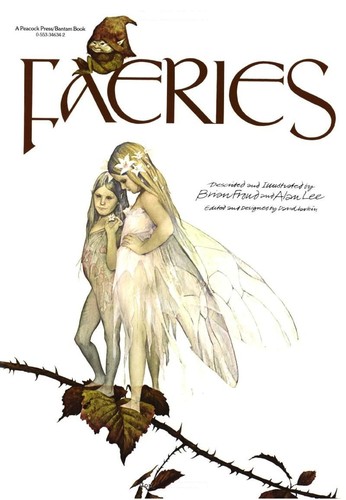
Brian Froud and Alan Lee’s Faeries arrived in 1978 from Harry N. Abrams in the United States and Souvenir Press in Britain, edited by David Larkin, and sold like a secret that had been waiting for color printing. It is staged as a naturalist’s survey of the hidden folk: handwritten-looking notes, plates, the implication of mud. Lee’s water and stone have a classical weather. Froud’s boggarts look as if they grew out of a root that resented you. The split is the point. The fae are not one costume.
Later anniversary and deluxe editions (a 2002 twenty-fifth, a 2010 deluxe collector’s edition with a Jane Yolen foreword and extra plates) are still the same argument in a thicker coat. Do not confuse the 2010 book with a twentieth-anniversary. The original date is 1978. The afterlife is proof that people wanted a book, not a poster of a sprite.
Tony DiTerlizzi’s later faux-Victorian field guides learn this lesson in a children’s key. The medieval bestiary as made object is the older cousin: a plate plus a note plus a claim that the creature has habits. Fantasy art books keep stealing that contract.
An island you could almost book a passage to
James Gurney’s Dinotopia: A Land Apart from Time (1992) is oil paint doing the work of a lie detector. Humans and dinosaurs share docks, libraries, and stairs that would have to exist if the premise were true. The pleasure is not “dinosaurs are cool.” The pleasure is architecture that has been thought through at the scale of a street. Imaginative realism, in Gurney’s sense, means the light on a brick is as stubborn as the light on a hide.
Wayne Barlowe’s Guide to Extraterrestrials (1979) does the same job for science fiction’s menagerie. Creatures from other people’s novels get the dignity of a zoological plate: stance, scale bar energy, the implication of a gravity and a diet. Speculative evolution owns the longer scientific-daydream of how a biosphere might go. Barlowe’s book is the portable museum.
Alan Lee’s The Lord of the Rings Sketchbook (2005) is a quieter object: pencil, wash, a landscape that had to be walkable. Tolkien owns the languages and the history. The sketchbook is what a hired pair of eyes does when a world already has maps in its bloodstream.
What this shelf is not
Kay Nielsen’s East of the Sun and West of the Moon (1914) is a Golden Age monument. If you are hunting that lineage, go to the locked illustrator essays. A Taschen slab of Nielsen is a reproduction of that era, not a “fantasy art book” in the Froud-Gurney sense, even if the bookstore shelves them together.
Shaun Tan’s The Arrival (2006) is a wordless graphic novel about immigration and uncanny civic machines. It belongs with fantasy graphic novels, where comic time and silence are the craft. Mention it so the searcher who meant “pictures of a strange city” is not abandoned. Do not let it eat the folio.
Moebius’s Edena cycle is line, desert, and a science-fantasy eye. Terryl Whitlatch’s anatomy books teach you why a wing joint is a joint. Those are neighboring rooms. The center of this query is still a heavy book that pretends, successfully, to be a document from elsewhere.
The souvenir is furniture. Next time you see a digital art dump labeled like a volume, ask whether you would clear a table for it. The ones worth owning still have a spine, a plate, and the slight embarrassment of looking at a creature that appears to have been waiting for you to turn the page.