A prose novel can tell you a tower is tall. A fantasy comic can make your eye climb.
Panel height becomes vertigo. A borderless splash becomes weather. A silent beat, a character looking at nothing, can outweigh a monologue because you are stuck in the looking with them. Scott McCloud and a century of cartoonists have said some version of this; the useful version is physical. The gutter, the white gap between images, is a stride the artist did not draw. Your mind has to take it. That is why the form suits fantasy. The unmapped is already in the page furniture.
Fantasy graphic novels worth keeping use that furniture for folklore, secondary worlds, and the kind of strangeness that wants to be stared at rather than paraphrased. This is not twenty-two covers with bullet points. It is a handful of books that teach different jobs the page can do.
Myth that has to be inked
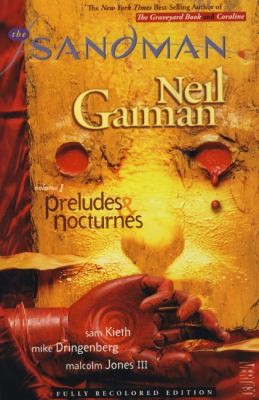
Neil Gaiman’s The Sandman, beginning in 1989 with Sam Kieth, Mike Dringenberg, and a rotating parliament of later artists, treats Dream as a personification who can be imprisoned in a glass circle for decades. When he gets out, the twentieth century has forgotten how to sleep. Lucien’s library, later, holds books dreamed and never written. Shakespeare wanders through. So do gods who have lost market share.
It became a flagship for a moment when comics were being sold as literature in better clothes. That is reception, not a virgin birth. What it still does, better than the television reception, is let artists change the weather issue by issue. How comics control time is the locked craft essay. Sandman is one of the cathedrals that craft built.
Mike Mignola’s Hellboy: Seed of Destruction (1994), with John Byrne on the first miniseries’ script, is almost the anti-cathedral: folklore as a silhouette. A stone right hand. A coat. Anomalous investigations that run on Russian stories, hollow-earth junk, and a lot of black. Mignola’s empty space is the monster. You read the darkness the way you read a woodcut. Lettering in such a book is part of the architecture; sound sits in the dark like furniture.
Together they answer two halves of the query. One is myth as a long, talkative institution. The other is myth as a shape you recognize from across a church.
The long walk and the paper epic
Jeff Smith’s Bone (1991–2004) starts as a funny-animal gag about three cousins lost in a valley and then, with a patience television rarely gets, becomes a high-fantasy war with cows, locusts, and a dream of the world as a thing that can end. The cartoon bodies stay cartoon. The plot does not stay small. That tonal cheat (Sunday-strip faces, winter-campaign stakes) is a specific graphic-novel trick. Prose would have to explain the joke. Smith just keeps drawing the same noses while the sky gets worse.
Hayao Miyazaki’s Nausicaä of the Valley of the Wind ran as manga from 1982 to 1994, around and beyond the 1984 film. The locked Miyazaki article owns the moving pictures. The books are the longer ecological argument: a toxic forest, insect gods, a princess who keeps trying to understand a world that can melt lungs. Thousands of pen drawings. If you only know the movie, the paper version is not a tie-in. It is the other half of the work.
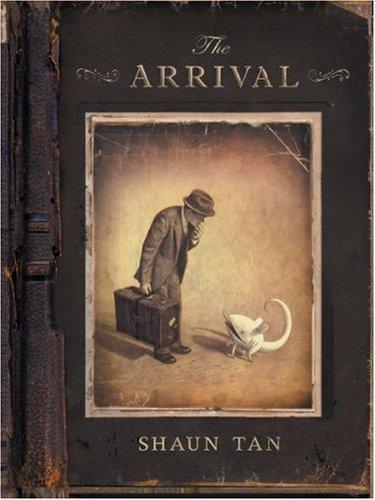
Shaun Tan’s The Arrival (2006) has no dialogue and does not need a map key. An immigrant walks into a city of impossible animals and incomprehensible notices. Graphite, sepia, the texture of an old album. It is fantasy because the city will not translate itself, which is also how a real arrival can feel. Fantasy art books may claim Tan for the plate. Here he belongs because sequence, not a single image, is doing the haunting.
Emily Carroll’s Through the Woods (2014) is five fairy-tale horror stories in black ink and a red that behaves like a spill. Girls, paths, things that follow you home in the stitching. It is the small, vicious end of the same query: not a thousand-page saga, a handful of pages that understand how a forest works in a picture book after the picture book has grown teeth.
What the rest of the shelf is doing
Around these, a compact neighborhood, not a second warehouse. Marjorie Liu and Sana Takeda’s Monstress: an alternate Asia of war and kaiju, painted like a brutal art-deco relic. David Petersen’s Mouse Guard: cloaked mice in autumn, watercolor as a woodland ordinance. Fiona Staples and Brian K. Vaughan’s Saga: space opera that still has to be drawn, which keeps it from becoming a pitch deck. Joe Hill and Gabriel Rodríguez’s Locke & Key: a house of iron keys, which is gothic architecture with a mechanic. Bill Willingham’s Fables: fairy-tale exiles in a city; a different project from this site’s own Fables work, and not a brand overlap to blur.
The test, if you are holding a thick fantasy comic and wondering whether it is this tradition or a novel with souvenirs: cover a caption. Does the page still move? Can you feel duration in the panel sizes? Is there a creature, a city, or a coat that would lose power if you only heard it described?
Tomorrow, when you turn any sequential page, pause in the gutter. That little white hallway is where the dragon, the immigrant, or the dream-lord actually travels. The artist left it blank on purpose. The fantasy is that you agreed to walk it.