Lights off, and the room starts filling itself in: claws in the wardrobe, yellow eyes under the bed, a sound outside the window that might just be wind.
G. K. Chesterton wrote something close to the truth of this, in 1909, though not the line most often attributed to him. His actual sentence, from Tremendous Trifles, runs: “The baby has known the dragon intimately ever since he had an imagination. What the fairy tale provides for him is a St George to kill the dragon.” (The tidier version many readers know, “fairy tales don’t tell children dragons exist… they tell children dragons can be beaten,” is Neil Gaiman’s paraphrase, written from memory for the epigraph of Coraline, and he’s said as much himself. Both versions land on the same point; only one of them is actually Chesterton’s sentence.)
Either way, the underlying claim holds: children don’t need to be told monsters are fictions. They already suspect otherwise. What a good monster picture book gives them isn’t reassurance that the dark is empty: it’s a St George. A way to hold the scary thing, turn the page at their own pace, and discover they have the tools to face it down.
What the Illustrator Is Actually Doing
The psychology is only half the craft. The other half happens in scale, silhouette, and the physical act of turning a page: decisions an illustrator makes about exactly how big the monster gets to look next to how big the child gets to look.
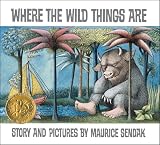
- Agency through eye contact. Max tames the Wild Things in Sendak’s spreads by staring into their yellow eyes without blinking: the composition puts him at their eye level, not cowering below it.
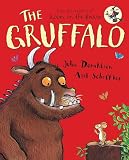
- Scale as the whole joke. The Gruffalo works because the mouse is drawn genuinely tiny against a genuinely enormous monster, which makes the eventual reversal (the mouse walking that monster through the forest by pure bluff) visually absurd in exactly the right way.
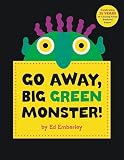
- The page-turn as a weapon. Ed Emberley’s die-cut design lets a toddler physically build the monster piece by piece and then, on the words “You don’t scare me!”, tear it back apart page by page. The mechanism of the book, not just the story in it, hands the child control.
- Negative space as the monster. In Monster, Scared, illustrator Zarah Juul renders most of the book in muted gray-brown, with claws and creeping faces bleeding in from the page edges and out of shadow, so the reader, like the child narrator, is never entirely sure whether they’re looking at a monster or at the dark doing what dark always does. It’s a genuinely different mechanism from the other four here: instead of resolving the monster into something tameable, it leaves the question open, and trusts the child to sit with that.
Five Ways In
Where the Wild Things Are (Maurice Sendak, 1963) remains the keystone: sent to bed without supper, Max’s room becomes an ocean and a forest, and he sails to the Wild Things (beasts with terrible roars and terrible teeth) and becomes their king before choosing, on his own, to come home to a hot supper.
The Gruffalo (Julia Donaldson, illustrated by Axel Scheffler, 1999) follows a quick-witted mouse who invents an imaginary monster to scare off predators, then has to out-think the real Gruffalo when it turns out to exist after all.
Go Away, Big Green Monster! (Ed Emberley, 1992) is less a story than a piece of engineering: die-cut pages that let a very young reader assemble a monster’s face and then dismantle it, on command, one feature at a time.
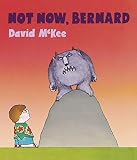
Not Now, Bernard (David McKee, 1980) is the darkest joke of the five: a purple monster eats young Bernard while his distracted parents keep saying “not now” without looking up, and the book never entirely resolves whether anyone noticed the difference.
Monster, Scared (Betina Birkjær and Zarah Juul, translated from Danish, 2023) is the newest and the most ambiguous: an attic monster that may be mostly built from a child’s own imagination, rendered almost entirely in shadow.
What They’re Actually Teaching
None of these five books argue that monsters don’t exist. They argue, each in a different register, that a child holding the book gets to decide what happens next: stare it down, outwit it, dismantle it piece by piece, laugh at its bad manners, or simply sit with the not-knowing until morning. That range, more than any single formula, is what makes a monster picture book worth handing to a child at bedtime instead of taking away.