October wants two incompatible things from a small child.
Costumes, a pumpkin with a crooked mouth, leaves that sound like paper under a shoe. And sleep. The books that fail this brief treat Halloween as a jump scare with a board binding. The books that succeed treat fright as something you can walk beside, joke with, or put to work.
Halloween picture books for children, when they deserve the search, are not a warehouse of every bat. They are a few machines. A cumulative chase that ends in a garden job. A broom that keeps making room. A skeleton dog who still knows the child’s name.
Why children need the dark woods already owns the moral case for letting stories be a little frightening. The locked essay on picture books as objects already sits with Laszlo and Jon Klassen’s The Dark: the basement as a tenant who happens to know where the spare bulb lives. Do not come here for a second basement. Come for October’s specific weather.
Clothes that follow you home, then get a job
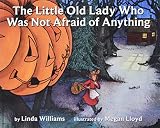
Linda Williams’s The Little Old Lady Who Was Not Afraid of Anything (1986), illustrated by Megan Lloyd, is a walk.
Two shoes. A pair of pants. A shirt, gloves, a hat, a pumpkin head. Each piece clomps or shakes behind her on the road. The text is built for a chorus: you can hear a group of children becoming the clothes. The old lady is not brave in the abstract. She is practical. She tells the empty scarecrow-parts what they are for, parks them in the garden, and goes to bed.
That is the craft in one hinge. Fear arrives as objects with sound effects. Courage is a use. The Halloween garden gets a guardian. Nobody has to be eaten. The dark is still on the road. It just got employed.
A broom that refuses to be exclusive
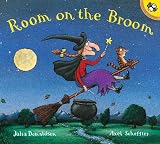
Julia Donaldson and Axel Scheffler’s Room on the Broom (2001) is not a haunted-house book. It is an autumn sky book that Halloween shops still need, because the witch is messy, kind, and full.
Hat, bow, wand: the wind takes them. A dog, a bird, a frog ask if there is room. There is, until there is not, and the broom snaps. A dragon arrives with appetite. The animals stack themselves into a mud-monster and shout. The dragon leaves. The witch builds a better broom with seats.
Scheffler’s pictures are warm on purpose. The scare is comic. The lesson is hospitality under load, which is a different gentleness from the old lady’s scarecrow. One book puts fear to work. The other makes room until the furniture breaks, then upgrades the furniture.
A dog who keeps the night anyway
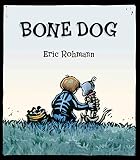
Eric Rohmann’s Bone Dog (2011) lets grief into Halloween without turning the holiday into a funeral.
Gus’s dog Ella dies. On Halloween, a skeleton dog finds him. The graveyard has bullies. Ella, as bone, still knows how to stand beside a child. Rohmann’s black-and-orange mass, the big paws, the grin that is a skull and also a friend: this is spooky as loyalty. The skeleton is not a dare. It is a continuation.
If you want Jack Skellington’s holiday mix-up, the Halloween animation essay and its locked cousins own dancing bones and the 1993 film Henry Selick directed from Tim Burton’s characters. Burton’s verse picture book is a separate object, a poem with spindly ink. It is not this page’s third machine. The third machine is a pet who did not consider death a sufficient reason to miss October.
Vintage Halloween art will give you the orange ink and the black cat as printed ephemera. Adult Halloween reading, still unapproved elsewhere on this site, is a different hour of the night.
The souvenir is a sorting question at the library display. Does this book give the scare a job, a seat, or a friend. If it only wants a flinch at bedtime, it is not doing Halloween’s domestic work. The pumpkin on the porch is already a face you made. The best of these pages teach a child the same trick: the dark can be arranged.