The classic western is already a story about a line.
Civilization on one side of the campfire, everything else on the other. Statute in the town, improvisation on the ride out. What weird western books add is the suspicion that the line was never merely legal. The desert had ordinances first. The canyon was a jurisdiction. The boomtown went up on a lid.
If you came here for a ranked corral of cowboy-versus-vampire paperbacks, you will get something more useful: how the good ones make the frontier feel unfinished, and a small set of books that actually do that work.
Cowboy hats plus a rented demon is pastiche. The real article starts when human law thins and the landscape does not.
The west was already half myth
Nineteenth-century dime novels and later pulps were happy to throw outlaws, mines, and the occult into the same cheap ink. The “weird west” label is newer, a way of shelving what those mixtures became once fantasy and horror had marketing departments. There is no single inventor to toast. There is a recurring physical joke: iron rails, telegraph wire, and steam, which look like the future, crossing ground that has not agreed to be modern.
That is why the subgenre keeps marrying nineteenth-century hardware to something older than the Louisiana Purchase. A locomotive is a magnificent object until it is also a punctured covenant. A revolver is a tool until it is a possessed career. Automata and clockwork belong in some of these books because a machine on a frontier is already a little blasphemous. It claims the desert can be scheduled.
Forgotten towns on this site are about places that remain as geometry after the people leave. The weird west is often those towns before they know they are dying, or after they have been occupied by a second population that does not pay tax.
A continent that was never finished
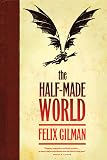
Felix Gilman’s The Half-Made World (2010) is the cleanest demonstration. The setting is a western continent that is still being made. In the west, reality has not quite set. Hills look unfinished. The Line is an industrial empire of demonic Engines and rail, a piety of timetables. The Gun is a scattered order of agents bound to weapons that are not metaphors. A doctor, a line agent, and a ruined paladin of the Gun converge on a weapon that might unmake the war. You can smell oil and uncreated dirt in the same sentence.
The fascination is not “cowboys, but magic.” It is the ontological insult. You can ride toward a horizon and find the scenery still wet. Colonial and industrial projects in our own history often behaved as if the map were empty enough to finish. Gilman literalizes the arrogance. The land has an unfinished edge, and both empires are trying to dry it in their own image.
Joe Abercrombie’s Red Country (2012) stays in his First Law world and still understands the western as a pursuit across a lawless Far Country: stolen children, a woman who will not stop, a quiet man whose past is a weapon. The supernatural here is thinner than Gilman’s. The weirdness is in the moral weather, the sense that civilization is a rumor you can outride. It earns a place because the frontier plot is doing real work, not because a wizard is riding shotgun.
Richard Brautigan’s The Hawkline Monster (1974) announces itself as “a gothic western” and then behaves like a deadpan fable. 1902. Oregon. Two hired killers, an isolated yellow Victorian, an ice cave, a family problem that is also a monster problem. Brautigan writes as if the dime novel and the haunted mansion had agreed to share a joke and then forgotten who was supposed to laugh. The ice under the house is the point. American gothic often puts the horror in the architecture. Brautigan puts a glacier in the basement and lets the west’s isolation do the rest.
Stephen King’s Dark Tower sequence is a cousin, not a brand-owner: a gunslinger walking a desert that has already become somewhere else. It shows how far the western silhouette can travel without remaining a historical costume. Mention it, then come back. This page is for books that still smell of alkali and timber.
R. S. Belcher’s The Six-Gun Tarot plants the whole carnival in Golgotha, Nevada: a boomtown sitting on a pit, a Mormon sheriff, an immortal, a scout, an alchemist. It is pulp in the honorable sense. The lid-on-the-desert image is the one to keep. Silver towns really did go up overnight over holes. The weird west only asks what the hole was for.
What the border is for
A useful test, if you are shopping or writing:
Does the landscape have agency, or is it a painted backdrop for a monster fight? Do the supernatural rules rhyme with historical sins (extraction, broken treaties, boom-and-bust, the lonely sheriff as a man pretending a town is a country), or are they stickers? Does nineteenth-century tech change the occult, or is the occult a costume on an ordinary western?
Folk horror often answers the soil question in villages that never moved. The weird west answers it in places that moved too fast: a street that was empty last year, a claim that should not have been staked, a railroad that cut a valley that was already occupied by something without a deed.
The souvenir is visual. The next time you see a photograph of a false-front main street, or a highway running toward a butte as if the butte had been asked, notice how thin the human layer is. The weird western is the literature of that thinness after it has started to answer back.
Keep the hats if you want. The older ordinance is in the dust.