Ten- and eleven-year-old readers are not asking for the sharp corners to be sanded off. They already know, from ordinary life, that adults don’t always have answers and that the world contains real shadows. What they’re asking a book to do is take that knowledge seriously.
The middle-grade fantasy that lasts does exactly that: real peril, real grief, moral choices without a clean answer waiting at the end of the chapter. Four books do it with unusual clarity, and one of them has a history worth knowing before you open it.
What Respect Actually Looks Like on the Page
Four things separate the middle-grade fantasy that lasts from the kind that talks down to its reader: stakes that don’t reset by the final chapter; characters who make real mistakes rather than illustrating a clean moral; magic that has weight and specific sensory texture rather than functioning like a video-game power meter; and protagonists who solve their own problems through observation and nerve, not a conveniently timed adult rescue.
The Dark Is Rising by Susan Cooper
Susan Cooper sets her 1973 classic in a snowbound Buckinghamshire valley during the twelve days of Christmas. On the eve of his eleventh birthday, which lands, deliberately, on the winter solstice, Will Stanton learns he is the seventh son of a seventh son: the last of the Old Ones, guardians sworn against the rising Dark.
That detail isn’t decorative. “Seventh son of a seventh son” is a genuine, long-recorded folk belief about inherited power passed down an unbroken male line: Cooper is borrowing real folklore, not inventing a fantasy rule from scratch, and she grounds the cosmic stakes in the tactile texture of an actual English winter: frozen pipes, snowdrifts against barn doors, rooks gathering in bare branches. Will carries his enormous, lonely duty quietly. Cooper never once lets him be an arrogant chosen one about it.
Coraline by Neil Gaiman
When Coraline Jones finds a door in the parlor that opens onto brick by day and an alternate flat by night, the Other Mother on the far side offers roast chicken, talking toys, and undivided attention, for the price of button eyes. What makes this a genuine test of nerve rather than a costume-shop scare is that Gaiman gives Coraline nothing supernatural to fight back with: an old seeing-stone, her own stubborn observation, and the refusal to be flattered into staying.
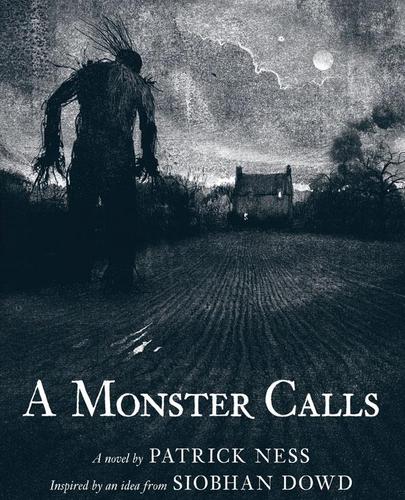
A Monster Calls by Patrick Ness, from an idea by Siobhan Dowd
This one has a history worth knowing. Siobhan Dowd, an award-winning children’s author, conceived the premise, the central characters, and the opening of the story while she herself was dying of cancer, and didn’t live to write it. Her editor at Walker Books, Denise Johnstone-Burt, who also happened to edit Patrick Ness, asked Ness to take Dowd’s beginning and finish the novel she couldn’t. Ness has been candid that he wrote it as his own book rather than attempting to guess at Dowd’s: the credit line, “from an idea by Siobhan Dowd,” is exact about where one writer’s project ends and another’s begins.
What arrived is a story about a boy named Conor, his mother’s terminal illness, and a yew-tree monster that shows up at seven minutes past midnight not to frighten him but to tell him three fables that refuse to resolve into tidy morals: a wicked queen turns out to have ruled well, a righteous parson turns out to be selfish, a murderer is still loved by his people. Illustrated by Jim Kay, the book won both the Carnegie Medal and the Kate Greenaway Medal in 2012, the only book ever to take both in the same year. It earns that distinction by refusing to let Conor’s grief resolve into anything simpler than what it actually is.
The Golden Compass by Philip Pullman
Pullman’s alternate-Oxford epic gives eleven-year-old Lyra Belacqua a shapeshifting daemon named Pantalaimon and sends her from the gas-lit cloisters of Jordan College to the frozen wastes of Svalbard, navigating adult corruption and outright theological tyranny along the way. Her only real weapon is the alethiometer, a golden instrument that answers truthfully, read not through study, but through Lyra’s own fierce, undereducated instinct. Pullman trusts that instinct completely, and the book never once apologizes for the size of the ideas it hands an eleven-year-old to carry.
Why All Four Belong on the Same Shelf
Cooper, Gaiman, Ness (writing from Dowd’s foundation), and Pullman are answering the same question from four different angles: what does a young reader deserve to be told about fear, loss, and moral complication, and how much can a story trust them to carry? Read together, the four books make the case that the answer is: considerably more than most children’s publishing assumes.