Chris Van Allsburg did not train as a painter. He trained as a sculptor, earning his undergraduate degree at the University of Michigan and his MFA at the Rhode Island School of Design, where he later taught. It shows in The Polar Express in a way that is easy to feel and worth being able to name: the oil-pastel illustrations are not built out of flat fields of color. They are built out of mass and light, the steam from the locomotive given real weight, the dark railcars lit like objects a sculptor has actually walked around and studied from more than one angle. Van Allsburg went on to win the Caldecott Medal twice, first for Jumanji and then, in 1986, for this book, and the sculptor’s eye is a large part of why the light in it feels less like decoration and more like something you could touch.
That is the standard worth applying to any winter or Christmas picture book under consideration: not whether it is warm and pretty, which almost all of them are, but whether the illustration technique is doing something specific enough to be named.
The Book That Refuses to Explain Itself
Raymond Briggs’s The Snowman passes that test by removing an entire tool from its own kit. The book is told with no words at all, in soft, textured colored pencil, following a boy whose snowman comes alive at midnight and takes him flying over glowing seaside towns and across the English Channel. The wordlessness is not a gimmick. It is the illustration technique: without narration to soften or explain what happens at dawn, when the boy runs downstairs to find only a puddle where the snowman stood, the reader is left with exactly what the pictures show and nothing more. Briggs trusts a very young audience with an ending that a text version would almost certainly feel obligated to comfort them out of.
A Poem, Two Illustrators of the Text, and One Illustrator of the Image
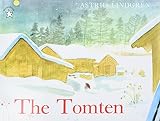
The most misunderstood book on any Christmas shelf is usually The Tomten, and the confusion is worth clearing up properly, because the actual chain of authorship is more interesting than the simplified version.
Viktor Rydberg wrote the original poem in 1881, describing a tomte, a small, ancient, bearded guardian spirit of Swedish farm folklore who moves silently among the barns and stables while the household sleeps, whispering to the animals that winter will end and spring will return. Harald Wiberg illustrated Rydberg’s poem for a Swedish picture-book edition published by Rabén & Sjögren in 1960 (after an earlier 1957 magazine appearance). Astrid Lindgren, who was the publisher’s own children’s book editor at the time, then wrote a new prose text specifically for the book’s international editions, working from Wiberg’s finished illustrations rather than the other way around. In Sweden, Wiberg’s pictures still run alongside Rydberg’s original verse; everywhere else, they run alongside Lindgren’s prose. Two different texts, one set of images, and an authorship credit that most editions compress into something less precise than what actually happened. Wiberg’s muted, softly indistinct palette is the throughline regardless of which text sits beside it, perfectly suited to a creature whose entire job is to be almost, but not quite, seen.
Trusting Silence on Purpose
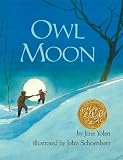
Jane Yolen’s Owl Moon, illustrated by John Schoenherr and winner of the 1988 Caldecott Medal, grew out of a real detail in Yolen’s own life: her husband’s enthusiasm for birding. The book follows a child and a parent walking through snowy winter woods at night in search of a great horned owl, and its central instruction to the reader is explicit inside the text itself, that when you go owling, you do not need words, only warmth inside and hope. Schoenherr’s watercolors hold to the same discipline the text asks of its characters: crisp blue-and-white cold, a single beam of flashlight, restraint everywhere a lesser book would have reached for spectacle.
What These Four Actually Share
Van Allsburg’s sculptor’s light, Briggs’s refusal to narrate, the real and specific authorship chain behind the Tomten, and Yolen and Schoenherr’s shared discipline of restraint are four different technical decisions, not four versions of the same generic seasonal warmth. What they share is a willingness to trust a young reader with quiet: a story that does not explain everything, illustrated by someone who understood exactly how much light, or how little text, that quiet actually needed.