The pilaster looks like architecture. Fluted, classical, glued into the facade of an eighteenth-century bureau as if it were holding the cornice up.
It is not holding anything up.
A finger goes into the cavity the central drawer has left behind, high against the underside of a dust board, and finds a thin leaf of seasoned ash. Press. Somewhere in the carcass an iron latch lets go. The pilaster slides forward by less than an inch. Pulled, it comes away as a tall, narrow stack of cedar drawers lined in velvet. Light has not been in there for a very long time.
That click is the whole subject. A secret compartment is not a metaphor for mystery. It is a void the maker stole from the thickness of wood, then spent extra labor making sure you would not notice the theft.
Desks that perform
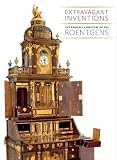
In Neuwied, on the Rhine, Abraham Roentgen and his son David ran a workshop that treated furniture as a kind of court entertainment. Marquetry was only the skin. Inside were counterweights, gut cords, steel linkages, and, on the most ambitious pieces, music.
The Berlin secretary cabinet of 1778–79, now in the Kunstgewerbemuseum, was made on speculation for the Prussian court and delivered to Frederick William II. It stands more than eleven feet high, crowned with a chiming clock. At the touch of concealed releases, doors and drawers move on their own. Wolfram Koeppe’s Metropolitan Museum monograph Extravagant Inventions is still the clearest public account of the piece: three related cabinets went to Duke Charles Alexander of Lorraine, Louis XVI, and the Prussian king. The mechanical wealth was largely the work of the workshop’s mechanicus Johann Christian Krause. Clockmaker Christian Kinzing belongs in the same Neuwied circle; the Berlin giant is not a one-man miracle. In 1786 Roentgen even swapped the center door for a new panel showing the king’s apotheosis. The furniture could be updated like a building.
What the spectator saw was a writing cabinet turning into a theatre. What the owner got was a private office that could be shut in the time it takes a visitor to cross a carpet.
The French royal version of the same appetite is the Bureau du Roi, the cylinder desk begun for Louis XV about 1760 by Jean-François Oeben and finished in 1769 by Jean-Henri Riesener after Oeben’s death. Riesener signed it at the Paris arsenal. The roll-top is a tambour of curved slats. A single key was supposed to govern the cylinder and the inner fittings; later restorers altered the original mechanism, so the famous “one turn opens everything” is partly documented craft and partly later reputation. The desk stood in the king’s inner study at Versailles, went to the Louvre after the Revolution, and returned to Versailles in the twentieth century. Diplomatic paper lived in wood because there was nowhere else for it to live.
A false drawer is the domestic cousin of all this pomp. The front matches its neighbors. The carcass stops short of the back. Behind the false bulkhead is a few inches of cedar. You have to know to take the drawer all the way out and press the peg. Before cheap coil springs, the push often came from that ash or hickory leaf: a slat bent into the rear wall, compressed when the drawer shut, waiting for the catch to fail. Grain matching did the rest. Cut the seam along a stringing line or a carved shadow and candlelight will not give you away.
A hide that had to hold a body
Elizabethan penal law made a Catholic priest in England a traitor. Families who housed one could lose more than furniture. The architectural answer was the priest hole: a cavity in a chimneystack, under a stair, inside a garderobe, or between a measured outer wall and a lying inner one.
Nicholas Owen (c. 1562–1606), a joiner of notably small stature, known as Little John, spent years building such hides while traveling as an ordinary carpenter. Jesuit sources and later conservation work agree on the method even where they argue about individual rooms: work at night, tell only the owner, sometimes build a decoy hide in front of a better one. He was captured after the Gunpowder Plot, tortured in the Tower, and died there in 1606 without giving a useful map. He was canonized in 1970 among the Forty Martyrs of England and Wales.
Harvington Hall in Worcestershire has the densest surviving set of hides in England; several are widely associated with Owen, though “Owen built this exact void” is, for most houses, a scholarly likelihood rather than a signed commission. Baddesley Clinton in Warwickshire is often identified with the 1591 search in which seven priests packed into one hide. Pursuivants did not glance and leave. They measured interiors against exteriors, sounded plaster, and could occupy a house for days. A hide that only fooled a tourist would have been a coffin.
Allan Fea’s old Secret Chambers and Hiding Places collected the romance of these rooms for a later audience. Walk the actual floors and the romance thins into carpentry under a death penalty: cramped, airless, and built by a man with a hernia and a damaged leg who still climbed into the thickness of other people’s houses.
Castle “escape tunnels” in folklore are mostly something else. Sally ports, posterns, and drains get promoted into secret passages because the story is better. Long-distance tunnels existed as rare engineering, not as a standard medieval kit. The priest hole is already strange enough without inventing a subway.
The box that will not open
In Hakone, south of Tokyo, woodworkers developed yosegi-zaiku: rods of naturally different-colored timber glued into a geometric bundle, then shaved into paper-thin sheets and applied like veneer. The mosaic is end-grain, not paint. That craft belongs to the late Edo period, often credited to Ishikawa of Hatajuku.
The himitsu-bako, the secret puzzle box, is a later marriage of that skin to a sliding mechanism. Histories usually place the distinct souvenir box in the Meiji period, with names such as Ryujiro Okawa recurring around the 1890s. You do not pick the lock. You move the sides in a sequence. Four moves, or forty, or more than a hundred on show pieces. The decoration conceals the seams. A traveler’s box-pillow that would not yield to a thief is sometimes offered as an ancestor; treat that as tradition unless a specific workshop document is in front of you.
Film and mystery fiction love the bookcase that swings. The real problem is weight. A loaded oak case will sag on ordinary hinges and scuff the floor, which is as good as a confession. Historic jib doors and library doors that actually work tend to hang on floor and ceiling pivots placed so the mass can be moved with a palm. Dummy spines exist. So do ordinary servant doors papered flush with a wall, which is concealment for symmetry rather than for spies. Production designers copy the silhouette. The click they want still comes from furniture.
Conservators find the rest of the story by accident. A bureau goes to the lab for worm, or for a broken lock, and a drawer shorter than its cavity turns up a packet of letters, a lock of hair, a coin the family no longer remembers hiding. X-radiography can show voids the eye misses; it does not require a cute genealogy connecting the cabinetmakers of Neuwied to the physicist who later gave his name to those rays. The hide was always a physical fact. We are the ones who forgot the combination.
A secret compartment is a human problem given to wood: a letter, a coin, a will, sometimes a person. The exterior is supposed to tell a boring truth. The interior keeps the expensive one. The question that stays is not whether the world is full of hidden rooms. It is whether this particular seam was cut on purpose, and what the person who cut it was afraid of.