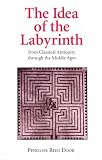
Step into a classical stone labyrinth and the first surprise is bureaucratic. There is nothing to decide.
The path does not fork. There are no joke dead-ends, no hedge that lies. A single line loops, doubles back, brushes the center as if arrival were about to be allowed, then flings you toward the rim again. After thirty paces the inner ear argues with the eye. Forward walking is supposed to mean progress. This geometry spends progress like a miser and then dumps you, politely, on the rosette.
A labyrinth, in the modern designer’s mouth, is unicursal: one continuous way in. A maze is multicursal: choices, traps, the architect as opponent. Ancient and Renaissance writers did not keep that filing system. Ovid’s labyrinthus is a prison you cannot solve. Italian gardens called branching puzzles labirinti. English maze comes from a word for bewilderment, the same family as amaze. The useful distinction is still worth keeping, as long as we admit it is a later clarity laid over a messy history.
Two philosophies of movement hide in the two geometries. One is ritual: surrender the compass, trust the line, feel the body paced by someone dead. The other is a test: remember, deduce, refuse the identical-looking corner.
Thread, palace, and a doodle on clay
The Western story starts, as it so often does, with a monster and an engineer. Minos wants a prison. Daedalus builds wander. Fourteen Athenian youths go in as tribute. Theseus takes a ball of thread from Ariadne, ties it at the gate, and walks back out along a homemade memory. English clue is that ball: clew, yarn, then any fact that leads you out.
Sir Arthur Evans, digging at Knossos from 1900, did not find a bull-man’s basement. He found a multi-storey Bronze Age palace of courts, magazines, stair, and light-wells: enough architecture to make a visiting Greek feel eaten. Whether the myth “is” Knossos is a scholarly brawl, not a tourist caption. The labrys (double axe) etymology for labyrinthos, once beloved, is now handled with tongs. The palace is real. The monster is literature. The confusion of outsiders in a vast house is, at least, human.
Long before Evans, someone at the Mycenaean Palace of Nestor at Pylos, around 1200 BCE, flipped an administrative clay tablet about leather goods and scratched a seven-circuit square labyrinth on the back. It is not a cathedral. It is a doodle. That may be the more revealing origin: the pattern as a thing a hand wants to complete, the way a margin wants a knot.
The same seven-circuit idea turns up on Knossian coins, Alpine rock, Cornish cliff, Roman mosaic floors where Theseus and the Minotaur occupy the medallion like a conquered riot under the dining table. Walk across that mosaic in a villa at Pompeii or Conimbriga and you are literally treading a conquered chaos on the way to dinner. Similar meander-and-man figures appear in other cultures, including the Tohono O’odham “Man in the Maze.” Resemblance is not a passport. Patterns travel, get invented twice, and get overloaded with meaning they did not ask for.
Stone that pretends to be a journey
French Gothic naves, roughly 1180–1250, put labyrinths under the feet of the congregation. Chartres still has the great one: about 12.89 metres across, a path on the order of 261.5 metres, dark stone inlaid in lighter limestone, eleven circuits, a six-petaled center. Later tradition called it la lieue, the league, because following it on the knees took about as long as walking a league of road. That nickname fed the pilgrimage legend; it does not prove an indulgence tariff. The brass or copper plaque that once occupied the middle was melted in the Revolution. Amiens kept an octagonal pavement with masons on a plate. Reims had a square labyrinth the canons destroyed in 1779, tired of children treating cosmic order as a game.
A modern legend says these floors were official substitutes for Jerusalem: walk on your knees, collect the indulgence, stay home. Thirteenth-century liturgical evidence does not support that as a standard Chartres regime. Hermann Kern and Penelope Reed Doob, among others, treat the kneeling-pilgrimage story as later romance. What we do have, richly, is Easter play. At Auxerre, clergy danced a pelota on the labyrinth, a ball passed, Victimae Paschali Laudes in the air: resurrection as a round, Theseus as a rumored cousin of the harrowing of hell. Chartres today can be walked on advertised days, shoes on, cameras out. That is a twenty-first-century use of a thirteenth-century floor, not a recovered medieval timetable.
Troy in the grass, fables in the hornbeam
Britain cut the pattern into turf: Julian’s Bower above the Humber, Saffron Walden’s huge bastioned ring, mizmazes in yew-shadow. Many were called Troy Towns, Walls of Troy, Julian’s Bowers. Virgil’s Troy Game sent young horsemen through interlaced drills. Folk imagination gave legendary Troy concentric, unbreachable walls. Parish scouring days kept the trenches from reverting to ordinary grass. The labyrinth, here, is maintenance as much as mystery.
Then the path grew walls.
Once hedges rise above the eye, the bird’s-eye gift of a cathedral pavement vanishes. Italian knot gardens and Serlio’s 1537 woodcuts still let you cheat by looking over. Yew and hornbeam at eight feet delete the horizon. You are in a corridor of chlorophyll. A hedge is a strange building material: it breathes, it holds dead hornbeam leaves in winter, it throws a velvet yew shadow, it changes color while the gravel plan stays put. Sound behaves badly. High frequencies die in leaf. Low voices bleed through, so a friend seems to stand in the next foot of air while being two minutes of walking away.
The Labyrinthe de Versailles, laid out by André Le Nôtre for Louis XIV between 1665 and 1674, was not merely a puzzle. It was a story engine: some thirty-nine painted lead fountain groups of Aesop, verses by Isaac de Benserade, a 1677 guidebook by Charles Perrault with Sébastien Leclerc’s plates so that Europe could walk the maze on paper. At a junction you might meet a fox staring at a raven with cheese, or a crane pulling a bone from a wolf’s throat, water standing in for speech. The Dauphin was supposed to collect morals with his shoes. In 1775 the expensive hornbeam came down for a fashionable open grove. Museum storage still holds animal heads. The garden itself is a ghost.
Hampton Court, planted about 1690 by George London and Henry Wise for William III, survived by being less literary and more rude. Oldest surviving hedge maze in Britain, later yew on a hornbeam memory, a third of an acre of paths that repeatedly bring you within gossiping distance of the goal and then send you along the perimeter like a fool. Parallel corridors are the cruelty: you hear the center, you see a scrap of it through leaves, and the route refuses. People still get mildly lost there on purpose. That is the point.
Late-nineteenth-century mirror mazes, Gustav Castan’s 1888 Spiegellabyrinth and the 1891 Petřín maze in Prague among them, finish the joke. Uniform overhead light kills the shadows your brain uses as a floor plan. Set mirrors at sixty degrees and a small room becomes an infinite colonnade of yourself. Every wall is a corridor until your palm finds cold glass.
Paper labyrinths, snow thread
Jorge Luis Borges did not need hornbeam. In “The Garden of Forking Paths” (1941) the maze is time choosing every branch. In “The Library of Babel” it is hexagonal rooms of total print. In “The House of Asterion” (1947) the Minotaur is lonely in an infinite house and wants the man who will kill him. Umberto Eco’s Aedificium library in The Name of the Rose is a building that weaponizes plan. Those books earn their keep because they remember that a labyrinth is a theory of knowledge, not only a weekend outing.
Cinema has a practical problem: the audience can see over the hedge. Stanley Kubrick and Roy Walker, adapting The Shining (1980), threw out King’s moving topiary and built an Overlook maze of timber and fake green at Elstree, floodlit through fake fog. Garrett Brown’s Steadicam stays at a child’s height so the walls loom like a grown-up. Inside the hotel, Jack leans on an architectural model of the maze, a god with a brandy; the cut to an impossible overhead of Wendy and Danny turning in the real thing makes the building a predator with a plan. Danny’s escape is Ariadne without the princess: he walks backward in his own footprints and hops off the line. The thread is snow.
Jim Henson’s Labyrinth (1986) lets the walls cheat, as storybook mazes should. Guillermo del Toro’s stone circle in Pan’s Labyrinth (2006) is half ruin, half border. One film is enough to steal from if you only carry Danny’s reverse steps. That is the perceptual souvenir: when you are lost, the ground may already contain the map of how you came, and using it may mean refusing to run forward.
The mapmaker’s paradox is the last turn. From above, every maze is a drawing and the secret dies. Estate engravings were once a private god-view. GPS is that view as a public utility. The art of the thing, unicursal or branching, only happens when the next corner is still a wall and your feet have not been told the answer.
Walk a pavement labyrinth if you can. You will not solve anything. You will notice that arrival can be delayed without anyone lying to you. That delay is older than the hedge, older than the guidebook, and still, inconveniently, a pleasure.