Charles Babbage died in 1871 with his great calculating engines still mostly on paper. Gears had been cut. Money had been argued over. The British government had flinched. The machine that would have turned mathematics into furniture never quite became furniture.
In 1991 the Science Museum in London finished a Difference Engine No. 2 from his later drawings. It is brass, iron, steel, and a peculiar kind of grief: the nineteenth century, reconstructed with twentieth-century patience, clattering through calculations the Victorians did not get to hear.
Best steampunk books are the literature of that sound arriving on time, or too early, or in the wrong empire. Goggles are optional. The boiler is not.
A joke that escaped the letter column
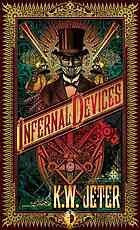
In April 1987, K. W. Jeter wrote to Locus about Victorian fantasies by himself, Tim Powers, and James Blaylock. He wanted a collective name “based on the appropriate technology of that era; like ‘steampunks,’ perhaps.” He was answering a review of Infernal Devices, his 1987 clockmaker novel of London doubles, fish-cult cellars, and devices that treat people as assemblies. Morlock Night (1979) had already shoved Wells’s Morlocks into a gonzo Victorian London.
The word was a wink at cyberpunk. Coal instead of chrome. It stuck harder than the wink.
What it named was not a brand-new emotion. Jules Verne had already taught adventure fiction to love a machine that could be drawn. Wells had already put a time machine in a suburban workshop. Steampunk, once named, became a way of asking a narrower question: what if the nineteenth century’s unfinished hardware (analytical engines, airships as routine transit, automata as labor) had actually gone into production, and culture had had to live with the soot?
If you only wanted automata as physical craft, that locked article is the workshop. This page is the bookshelf where the workshop has consequences.
Computers made of steam
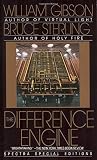
William Gibson and Bruce Sterling’s The Difference Engine (1990) remains the hardest specimen. Lord Byron’s Industrial Radicals run Britain. Babbage’s engines exist as multi-story clattering bureaucracies. Punched cards track persons. London is an information city that still smells like coal. You can almost hear the lubrication problem: a computer that needs grease, attendants, and a hall big enough for a millwheel.
The pleasure is not gadget tourism. It is class and surveillance wearing Victorian clothes that do not quite fit, because the clothes were cut for a slower century. Alternate history as a wider query lives next door. This novel is the steampunk version of that query: the fork is a machine that almost existed.
Jeter’s Infernal Devices is wetter and ruder. A clockmaker’s heir inherits a London that has been secretly duplicated in brass. Watch-springs, false faces, a cellar that believes people are assemblies. The book is why the Locus letter had a specimen to point at. If The Difference Engine is the engine room of the state, Jeter is the workshop where the private inventor has gone wrong on purpose.
Cities that eat, and cities that breathe soot
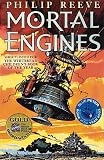
Philip Reeve’s Mortal Engines (2001) answers a child’s serious question: what if municipal pride had treads? Traction Cities hunt towns across a chewed future. London is a predator with a jaw of scaffolding. The airship Jenny Haniver is famous from later films; in the book the scandal is municipal Darwinism, a parody of empire that has learned to roll. A town can be eaten. That is the image that earns the airship, not the other way around.
China Miéville’s Perdido Street Station (2000) is often shelved beside steampunk and is not a polite member of the club. New Crobuzon runs on steam, thaumaturgy, and an industrial cruelty that has nothing to do with cosplay. Miéville helped name the New Weird and has been openly impatient with steampunk as a lifestyle sticker. Read it anyway if you want the industrial city as a biological event: pistons, moths, a crisis that cannot be oiled back into order. It teaches what the costume version keeps skipping. The machine is a politics.
Those two books, side by side, stop the genre from being only London 1887 with extra brass. One is young-adult apocalypse with a civic mouth. The other is a grown-up bruise.
After the London default
Once the name existed, writers started taking the boiler elsewhere.
Ian Tregillis’s The Mechanical (2015) gives the Dutch a labor force of clockwork people bound by alchemical compulsion: a geas in brass. The question is not “what if robots, but Victorian.” It is “what if the soul is a winding key, and the empire is the locksmith.” That is the automata article’s cousin in novel form.
P. Djèlí Clark’s A Master of Djinn (2021) sets 1912 Cairo as a capital where magic and machinery have already had their conference. Pneumatic transit, clockwork, djinn, an anti-colonial mystery. It is useful because it refuses the idea that the only century that could have gone strange is Britain’s.
Around these, a whole bazaar: Cherie Priest’s blighted Seattle, Scott Westerfeld’s living airships versus walking guns, Natasha Pulley’s watchmaker London, Ekaterina Sedia’s automaton who holds her own key. They can wait. The searcher who typed steampunk books needed the mechanism first, not a warehouse of covers.
Goggles, incidentally, were mining and aviation equipment before they were a personality. The literature worth keeping is interested in what the goggles were for: dust, altitude, a factory that does not love eyes.
The souvenir is auditory. Somewhere a reconstructed Babbage engine still runs for visitors. Listen to the carry of metal on metal. That racket is the genre’s true nostalgia. Not a sepia filter. A century that almost computed, and the stories that asked what it would have done to the people standing next to the millwheel when the millwheel learned their names.