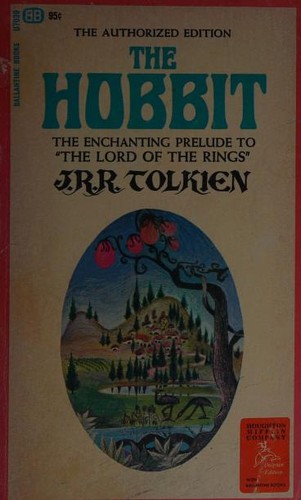
The Hobbit does not open with a battle, a prophecy, or a map unrolled across a table. It opens with a door.
Bilbo Baggins spends the book’s first chapter being talked out of his own comfort by thirteen dwarves and a wizard who simply will not leave, and the actual moment of departure, sprinting out without a hat, a walking-stick, or any money, leaving his contract behind on the mantelpiece, is played for comedy, not heroism. That is the part worth noticing. J. R. R. Tolkien does not need Bilbo to want the adventure. He needs the adventure to become, briefly, less embarrassing than staying home. Everything the book does afterward depends on that small, undignified push.
This is the real subject of fantasy adventure fiction: not the destination, but the specific mechanism that gets a reluctant person moving and keeps a reader wanting to follow them. Four books do this four different ways, and none of them do it with a numbered list of virtues. They do it with structure.
The Shrinking House Behind You
The Hobbit’s real trick is not the road ahead. It is what happens to the road behind. As the dwarves and Bilbo put more distance between themselves and the Shire, Bag End does not simply recede; it becomes less and less relevant to the problems actually in front of them. By the time Bilbo is bargaining with Smaug in the dark under the Lonely Mountain, his hobbit-hole is not even a comfort to long for. It is a different scale of problem entirely, almost unimaginable from where he is standing. Tolkien’s own life gives this a real hinge, even if only in general terms: he served in the trenches on the Somme in 1916, and decades later, in a 1960 letter, said plainly that the Dead Marshes of The Lord of the Rings “owe something to Northern France after the Battle of the Somme.” That later, harder book is explicit about a landscape scarred past recognition; The Hobbit, written and published earlier and lighter in tone, still runs on the same underlying mechanism: a home that becomes smaller and stranger to think about the farther the traveler gets from it, until home itself has to be earned back by the return.
The Wall That Someone Has to Guard
Neil Gaiman’s Stardust solves the threshold problem by making the threshold an actual, maintained piece of infrastructure. The stone wall separating the English village of Wall from the land of Faerie is not simply there; it is guarded, in rotating shifts, by the village’s own residents, who take the job seriously enough to physically stop young Tristran Thorn from crossing it uninvited. Once every nine years, a market opens on the other side, and the villagers cross under supervision, buy strange goods, and come home. Gaiman’s threshold works because it has bureaucracy attached to it, a threshold that people have organized their whole community around managing is a far more convincing boundary than a line on a map, precisely because someone has clearly decided it needs watching.
The Horizon That Will Not Hold Still
Lord Dunsany’s The King of Elfland’s Daughter (1924) does something structurally stranger than either of the above, and it is worth noting why the book still matters: both H. P. Lovecraft and J. R. R. Tolkien read Dunsany with open admiration, Lovecraft going so far as to say that no description could convey more than a fraction of “Dunsany’s pervasive charm.” What Dunsany actually does with distance in this novel is the reason later fantasy writers kept returning to him. Elfland does not sit at a fixed number of miles past “the fields we know.” The border retreats as characters approach it, so that arriving is never simply a function of walking far enough or fast enough, it becomes a question of whether the timeless country will permit the approach at all. That is a genuinely strange piece of narrative engineering, and it makes the ache of the quest less about physical stamina and more about a longing the landscape itself seems to be actively managing.
Terrain That Argues Back
William Goldman’s The Princess Bride takes the opposite approach from Dunsany’s shifting horizon: instead of distance that will not resolve, it gives its travelers terrain that actively fights them, obstacle by named obstacle. The Cliffs of Insanity, the Fire Swamp with its lightning sand and flame spurts, the Zoo of Death, each one is staged less like scenery and more like an argument the landscape is making against the characters’ survival, which the framing device (a grandfather reading the story to his sick grandson, cutting in to comment on the “good parts”) lets Goldman treat with constant, knowing humor without ever losing the actual stakes. The road here is not a passive backdrop the characters move across. It is closer to an opponent with its own escalating list of objections.
The Common Machinery
Strip away the settings and each of these four books is doing the same basic thing through a different mechanism: making the space between “home” and “there” into something with its own pressure, its own rules, and its own reason the reader cannot simply skip ahead. A door that becomes hard to walk back through. A wall that someone has organized their life around guarding. A horizon that will not sit still. A swamp that seems to be taking the argument personally.
That is what makes a road impossible to ignore. Not wanderlust in the abstract, but a landscape built with enough internal logic that leaving it, or reaching the far side of it, actually costs the traveler something specific.