The paperback dragon often arrives preassembled: four legs, furnace, a hoard, opinions. Film posters did that work. So did games.
Dragon fantasy books for adults are more interesting when they refuse the assembly. A dragon might be something you measure. Something you are posted to, like a ship. Something two cultures cannot agree how to worship. Something that bonds to a rider because a spore is falling from the sky.
The old creature (gaze, coil, gold, rain) already has a locked history: dragons before fantasy novels. Tolkien already owns Smaug as the modern western crystallizer. Le Guin already owns Earthsea, where dragons are not a cavalry. This page is the later shelf: novels that give the body a job besides being slain.
A memoir that wants bone, not a joust
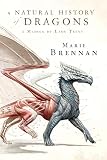
Marie Brennan’s A Natural History of Dragons (2013) is framed as the late-life memoir of Lady Trent, a woman who would rather be in the mountains with a notebook than in a parlor with a reputation.
The book is an expedition diary that happens to contain rock-drakes. Wing, nest, chemical ecology, the social cost of a female naturalist in a society that did not budget for her. Vystrana is invented geography. Treat it as the novel’s weather, not a place you can cite to a gazetteer. The fascination is the posture. The dragon is an animal with habits. Wonder arrives as attention, not as a coronation.
If you wanted Beowulf’s stolen cup, the folklore essay still has the barrow. Trent wants a specimen and a sentence that will stand.
A captain, an egg, a new kind of navy
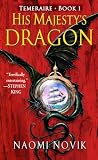
Naomi Novik’s His Majesty’s Dragon (2006) asks what the Napoleonic Wars look like if nations keep an Aerial Corps of speaking combat dragons.
Captain Will Laurence captures a French ship carrying an egg. The hatchling, Temeraire, a Chinese celestial, bonds to him with the speed of a naval accident. The rest is manners, rigging, and the problem of a weapon that can talk back. Patrick O’Brian’s readers will recognize the duty. The dragon changes the physics of the duty. You do not “have” Temeraire the way you have a horse. You are posted together.
This is adult dragon fantasy as logistics and friendship under military law. The awe is in the size of the body on a deck, and in the fact that the body has opinions about China, mathematics, and whether Britain is behaving.
Two skies that do not share a theology
Samantha Shannon’s The Priory of the Orange Tree (2019) is a large standalone (a later companion novel exists) in which dragons are not one species with paint options.
In one part of her map, fire-wyrms are apocalypse, the Nameless One, a western dread. In another, water dragons are sacred, weather, a different covenant. Court, queens, knights, and a world that has to live with both. You can argue with the length. You cannot argue that the book treats dragon as a cultural technology. People organize religions around the body. That is a different mechanism from Trent’s calipers or Laurence’s harness.
Anne McCaffrey’s Dragonflight (1968) is the border with science fantasy. Pern’s riders Impression-bond to dragons and burn Thread from the sky. The novel collects material that had already won: the novella “Weyr Search” took the 1968 Hugo, “Dragonrider” the 1968 Nebula. Lost colonial technology, a biological threat from space, telepathy as a working interface: the locked science-fantasy essay owns ritualized tech in Wolfe and Muir. Pern is what that scandal looks like when the relic is a golden queen and a boy who can fly.
Do not flatten it into “the original dragonrider book” as a patent. It is the famous English-language template for bonded flight, and it is also, stubbornly, a science-fiction problem wearing wings.
The souvenir is a question you can take into a shop. What is this dragon for in the book you are holding. A specimen. A comrade. A schism. A planetary immune system. If the answer is only “cool cover, breathes fire,” you have not yet opened an adult dragon novel. You have opened a poster. The old wyrm in the barrow can wait. These books want you to stay long enough for the mind inside the furnace to finish a sentence.