Genre marketing likes a wall. Science fiction on one side, with orbits and budgets. Fantasy on the other, with swords and inherited trouble.
Science fantasy is what happens when a writer walks through the wall and refuses to apologize. A starship still needs a corridor. A necromancer still needs a body. The interesting part is the posture. In these books, a fusion plant, a spice, a calendar, or a sword can be handled the way a relic is handled: with procedure, dread, and not quite enough explanation.
Arthur C. Clarke’s Third Law, from Profiles of the Future, is the portable hinge: any sufficiently advanced technology is indistinguishable from magic. Clarke on deep space owns the stare into the dark. This page owns the cultural consequence. If the manual has been lost for ten thousand years, the remaining operators will look like priests. They may also still be engineers. The labels stop helping.
Mass culture already taught the recognition. Lightsabers, an order with robes, a farm boy, a space opera that behaves like a fairy tale. You do not need that film named at length. You need the book version of the same scandal: wonder that has not chosen a department.
Urth, where the hull is a castle
Gene Wolfe’s The Shadow of the Torturer (1980) opens The Book of the New Sun. The sun is dying. The city is full of residual machines. Severian, apprenticed to a guild that performs executions, carries a sword named Terminus Est through a world that later readers label dying-earth or science fantasy because neither “wizard” nor “astronaut” will sit still.
Ray guns, when they appear, are handled like talismans. Architecture recycles hulls. Language is thick because the culture is thick: too many empires have already happened. Wolfe is not mixing genres as a stunt. He is describing what deep time does to tools. You can still cut a throat. You cannot always say, in clean modern prose, what the tower used to be.
If you want the older adventure of simply going, Verne packed the bag. Wolfe unpacks a relic and asks you to live with not knowing the operating system.
Bone, exams, and a solar system of houses
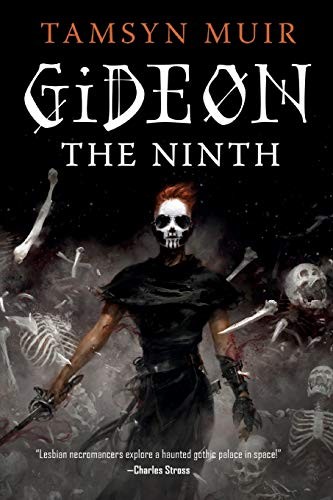
Tamsyn Muir’s Gideon the Ninth (2019) is louder, funnier, and just as serious about ritual technology. Necromancers of the Nine Houses travel to Canaan House to sit a lethal scholarship. Gideon is a swordswoman in a decaying gothic space empire. The jokes are filthy. The palace still has to be walked.
What makes it science fantasy rather than “goth in orbit” is the way flesh, thanergy, and imperial history are treated as a physics you can fail. The locked-tomb gothic is not costume. It is the remaining user interface.
Spice, pilgrimage, calendar
Frank Herbert’s Dune (1965) is filed as science fiction in every bookshop that wants to stay calm. It is also the century’s most successful argument that ecology, prophecy, and an order of women with a long game can occupy the same desert as stillsuits and interstellar politics. Spice is not a magic potion with a serial number. It is a sacrament that happens to be an export.
Dan Simmons’s Hyperion (1989) is primarily space opera: a frame like the Canterbury Tales, seven travelers, a distant world, Time Tombs, the Shrike. Keep it in the constellation as mythic furniture on a starship timetable, not as a second Wolfe. The pilgrimage structure is the fantasy inheritance. The rest is future war and grief.
Yoon Ha Lee’s Ninefox Gambit (2016) goes further into ritualized physics: calendars as weapons, heresy as a firing solution. Mention it as a modern extreme. Do not pretend it is a cozy gateway.
First contact owns the moment something answers. Wells owns invasion as modern nightmare. Science fantasy is adjacent and distinct. The alien is often already us, wearing the leftover machines.
The souvenir is a question you can take into a museum or a cinema. When a culture has had a tool longer than it has had a written explanation, does it look like engineering or like liturgy. The best science fantasy books refuse to choose, because the people inside the story cannot choose either. They still have to pick up the sword, or the relic, and walk down the corridor.