Weak urban fantasy uses a city as wallpaper. Neon. Coffee. A wizard who could have been standing in a forest with the same staff.
The books that justify the search term treat brick as memory. Victorian sewers, a disused platform, a buried river, a property line: these are not scenery. They are the surviving older architecture under the asphalt. Magic, in this strain, has a postcode.
The Fair Folk already own the older countryside danger, the people who are not tiny and not kind. Urban fantasy is what happens when that kind of otherworld has to share a street with parking enforcement.
London, with the names still employed
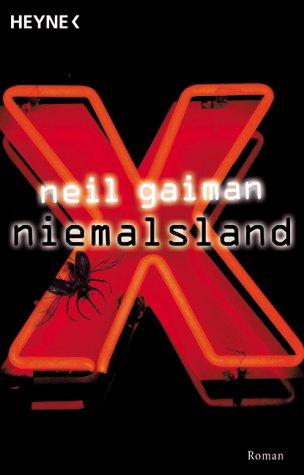
Neil Gaiman’s Neverwhere arrived in 1996 as a BBC series and as a novel, close enough together that the city had two doors into the same idea. Richard Mayhew, a forgettable London office worker, stops for a bleeding girl named Door. London Above stops seeing him. London Below takes his coat.
The joke that keeps paying is cartographic. Earl’s Court is a court. Blackfriars have a job. The Angel of Islington is not a pub sign in the way tourists mean. The Floating Market moves through the city’s closed rooms: a department store after hours, a battleship, some other civic interior that is supposed to be empty. Do not freeze one famous location as the only altar. The point is that London’s unused hours are a second municipality.
Gaiman literalizes a map you already half-knew. That is urban fantasy’s cleanest trick. The reader has ridden the train. The book hires the names.
Rivers with jurisdictions
Ben Aaronovitch’s Rivers of London (2011) puts a probationer, Peter Grant, in Covent Garden with a ghost for a witness and recruits him into the Folly, a police department of two that still files Newtonian magic as if it were a slightly embarrassing specialism.
The gods of the city are the rivers. Father Thames and Mama Thames split tidal water from urban water. Buried tributaries (Fleet, Tyburn, and their sisters) behave like family with territory. You can argue with a goddess, in this series, the way you argue with a council about a boundary. The comedy is jurisdictional.
Isaac Newton, in the backstory, wrote more than gravity. The series treats spellwork as paper, Latin, and practice, which is why the procedural texture holds. A murder still needs a notebook.
The city you are trained not to see
China Miéville’s The City & The City (2009) is only urban fantasy if you stretch the label until it covers sociology. Inspector Tyador Borlú works in Besźel. Ul Qoma occupies much of the same ground. Citizens are taught from childhood to unsee the other city’s people, cars, and shopfronts. A glance that acknowledges the overlap is Breach, and Breach is an authority that does not care about your novelistic feelings.
Call it New Weird, speculative noir, or a thought experiment with police procedure. Keep it in this constellation because it is the purest version of the thesis. A city is a set of trained attentions. Magic, here, is the legal duty not to notice.
Liminal horror owns corridors that have clocked out of their jobs. Miéville’s crosshatch is a cousin: space that is employed by two employers at once.
Forgotten towns own a different scale of civic haunting. Noir’s older city night, before the name, taught cameras how to make streets look like fate. Urban fantasy borrows that wet asphalt and asks it to remember a god.
Other strains, briefly
Emma Bull’s War for the Oaks (1987) is one of the American books people point to when they want a founding date: Minneapolis, bands, a fairy war that has to use a modern city as ground. Jim Butcher’s Harry Dresden, starting with Storm Front (2000), is the yellow-pages strain. A wizard in the directory, a basement office, Chicago winter, a camp stove. It is more detective series than municipal myth, which is why it satisfies a different reader. Mention it so the search is honest. Do not let it eat the brickwork.
The souvenir is a way of walking. Next time you pass a storm drain, a closed station, a river that has been forced underground, or two crowds occupying one pavement without quite looking at each other, ask which architecture is on duty. The best urban fantasy books do not import magic into a city. They notice that the city was already a spell with bylaws.