Opening the first volume of an epic fantasy series is an unusual human transaction.
You are not buying an evening’s distraction. You are making a contract of time: agreeing to inhabit an invented continent across thousands of pages, tracking dynastic lineages, memorizing mountain passes, and watching characters age across several actual years of your own reading life.
When an epic series fails, the exhaustion is physical. Bloat replaces momentum, battles blur into identical clashing steel, and you feel dragged through filler. When a vast saga succeeds, the invented world stops being ink on paper. It becomes a place you once lived, and in the strangest cases, a place its own author had to leave unfinished for someone else to carry you the rest of the way home.
How to Calculate the Time Investment
Before dedicating months, or years, to a shelf of a dozen or more volumes, an honest reader needs to weigh four distinct dimensions of scale:
- Narrative Density vs. Raw Word Count: A 400-page novel packed with political maneuvering can demand more attention than a 1,000-page travelogue where characters spend three hundred pages crossing an empty moor.
- First-Volume Pacing Curves: Almost every legendary saga starts slow. The author must lay the foundations of agriculture, religion, dialect, and architecture before the kingdom can plausibly collapse.
- The Emotional Cost of Continuity: Sagas following one protagonist across decades demand a different stamina than multi-perspective mosaic epics, where you must be prepared to watch a dozen characters suffer permanent scars in parallel.
- Finished Sagas vs. Lifetime Commitments: There is real satisfaction in a world whose final volume is already bound and on the shelf, where every foreshadowed thread reaches its destination, sometimes because the original author fought to make sure it would.
Four Monumental Sagas That Justify Every Hour
The Wheel of Time by Robert Jordan (and Brandon Sanderson)
No series on this list makes the “piece of your life” metaphor more literal. Robert Jordan began The Eye of the World in 1990 and spent seventeen years building a cosmology of Ages that turn like a wheel, an Aes Sedai magical order splitting along gendered lines, and a farm boy named Rand al’Thor slowly, agonizingly, becoming the prophesied Dragon Reborn across fourteen volumes.
Jordan died in September 2007 of cardiac amyloidosis, in the middle of writing what he intended as the final book. He had spent his last months dictating chapters and leaving detailed notes precisely because he knew he might not finish, and his widow and editor, Harriet McDougal, chose fantasy author Brandon Sanderson to complete the series from that material. What was meant to be one closing volume grew, under the sheer weight of Jordan’s unresolved plot threads, into three: The Gathering Storm, Towers of Midnight, and A Memory of Light.
The investment curve: Fourteen books, completely finished, by two hands rather than one. Few series make the stakes of “giving a piece of your life” this concrete, because Jordan quite literally gave the rest of his to make sure the ending arrived.
The catch: The middle volumes are notorious for slowing to a crawl under the weight of the world Jordan built. Readers who push through are rewarded with one of the most seismic final-book payoffs in the genre’s history.
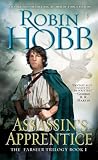
Realm of the Elderlings by Robin Hobb
Comprising sixteen volumes across five interconnected sub-series, beginning with The Farseer Trilogy, Robin Hobb’s chronicle of the Six Duchies is the summit of character-driven epic fantasy. It follows FitzChivalry Farseer, royal bastard and trained assassin, through the aristocratic, mind-linking Skill and the ostracized, beast-bonding Wit. Fitz is not invincible. He is a wounded, deeply flawed human being whose choices carry heartbreaking consequences across forty years of in-world history.
The investment curve: Sixteen books, completely finished. Read the first trilogy as a self-contained arc before deciding whether to follow Fitz into the liveship traders of Bingtown, or into old age.
The catch: Hobb does not write escapist power fantasies. If you cannot tolerate slow-burning grief and characters making agonizing mistakes under pressure, this series will break you on purpose.
Memory, Sorrow, and Thorn by Tad Williams
Published between 1988 and 1993, Tad Williams’s landmark trilogy (The Dragonbone Chair, Stone of Farewell, To Green Angel Tower) served as the vital bridge between Tolkien’s mythic romance and modern grit. Set on the continent of Osten Ard, the story begins inside the sprawling royal fortress of the Hayholt, where an orphaned scullery boy named Simon wanders dusty attics and kitchen basements before an unnatural winter descends, accompanied by the ancient, non-human Norns.
The investment curve: Three massive volumes, one of the most thoroughly resolved conclusions in modern fantasy.
The catch: The first two hundred pages demand patience. Williams spends chapters on Simon chasing cats and washing pots before the high adventure begins. Trust the slow build.
The Earthsea Cycle by Ursula K. Le Guin
Proof that epic storytelling does not require six thousand pages of battle choreography. Across six slim, luminous books, starting with A Wizard of Earthsea in 1968 and concluding with The Other Wind in 2001, Le Guin created an entire archipelago of language, ecology, and philosophical depth. Following Ged from reckless youth, through his years as Archmage, to quiet retirement as a goat-herder, Earthsea grounds its magic in the Old Speech: knowing the true name of a thing, and understanding that every spell alters a delicate equilibrium.
The investment curve: Six short books, easily read in a month, demanding a lifetime to fully unpack.
The catch: Readers looking for kinetic fight scenes and hard-magic power progression will miss the quiet spiritual power of the archipelago.
Scale and Consequence in Wolfesque
In the world of author A. P. Wolf, epic scope is measured in moral consequence rather than square mileage. In projects like The Hollow Bell, ancient histories echo through cold valleys, and the survival of a valley depends on keeping faith with forgotten covenants.
For readers who want the opposite discipline, one complete world in a single volume rather than a decade-spanning commitment, the Wolfesque guide to standalone epic fantasy covers that ground. To explore further journeys into expansive worlds, visit our dedicated Epic Fantasy directory and browse our High Fantasy shelves.