The house lights are still up. A newsreel has finished. Then a seven-minute film starts that has no stars you can interview in a hotel lobby, only drawings that behave as if the camera were a dare.
That is the original job of classic cartoons. They were theatrical shorts, booked in front of features for paying adults, scored like miniature musicals, drawn on cels, photographed a frame at a time under a rostrum camera. Television later inherited them, recut them, and taught a generation that they had always been babysitting. The paint does not agree.
This is not a warehouse of every mascot with gloves. It is a compact map of the Golden Age American short, roughly the late 1920s through the 1950s, and a set of locked doors for the studios that already have full essays on this site.
Seven minutes, a pit orchestra, a law of timing
A short had to land before the feature stole the night. That constraint is why the form feels denser than a half-hour sitcom drawn in the same ink. Gags are built in frames. A hold is a decision. A smear is a decision. The audience in 1935 did not need a children’s demographic to laugh at a skeleton dancing in a graveyard.
Disney’s The Skeleton Dance (1929), a Silly Symphony animated largely by Ub Iwerks and scored by Carl Stalling while he was still in that studio, is an early proof. Dirt, bones, a fox-trot of the dead, drawn as if the graveyard were a nightclub that had not asked permission. Disney’s Golden Age owns the later cathedral of character acting and the Nine Old Men. This page only needs the laboratory: the Silly Symphonies as a place to test music-and-motion before a mouse had to carry a feature.
If you want the physical joke of a coyote who does not fall until he notices the missing cliff, that grammar lives in why classic cartoons could break physics. Do not steal that essay’s punchline. The constellation here is historical and optical: who was drawing, for which screen, under which house style.
Rubber hose and a New York night
Hollywood did not have a monopoly on strangeness. Max and Dave Fleischer’s New York studio made figures whose elbows were suggestions. Limbs behaved like garden hose. Jazz was not a background cue. It was a second performer.
Betty Boop’s Snow-White (1933) is the pre-Code exhibit. Cab Calloway’s dance, rotoscoped onto Koko the Clown, turns a fairy-tale stub into a nightclub possession. The Fleischer rubber-hose essay owns the studio’s turntable process, the muttering Popeye ad-libs, the way a cartoon could feel like a machine that had learned to sweat. Popeye the Sailor Meets Sindbad the Sailor (1936) is the two-reel color flex: depth that is a physical set on a rotating apparatus, not a software fog.
Watch those shorts as urban modernism that happened to be funny. Then let the locked Fleischer page take the workshop tour.
Termite Terrace, then the volume knob
Warner Bros. cartoon unit, nicknamed Termite Terrace, treated the seven minutes as satire you could hum. Bob Clampett’s Porky in Wackyland (1938) is still a shock: a landscape that refuses to stay a landscape, a Porky who has wandered into someone else’s nervous system.
Chuck Jones’s Duck Amuck (1953) is metacinema with a pencil. Daffy is erased, restaged, given the wrong background, forced to negotiate with an animator who is also a bully. What’s Opera, Doc? (1957) puts Wagner through a meat grinder and somehow keeps the grandeur: Maurice Noble’s layouts, a horse, a helmet, a joke that knows the music is real. Jones and the geometry of the gag owns the Coyote’s retrospective “laws,” the holds, the posture. Carl Stalling owns what happens when a downbeat is a weapon. This page only needs you to hear that these were not doodles. They were timed.
Tex Avery, at MGM, treated timing like a volume knob someone had broken off. Red Hot Riding Hood (1943) is adult theatrical comedy in wolf form: takes that go on too long, eyes that leave the skull, a fairy tale that has wandered into a nightclub and decided to stay. Hanna and Barbera’s Tom and Jerry theatricals, scored with ferocious particularity by Scott Bradley, are the other MGM argument: violence as dance, not as a Saturday-morning template. The later television versions taught a different patience. The originals still snap.
When the backgrounds went flat on purpose
United Productions of America did not lose the ability to draw a circle. They refused the house style that said every fold of cloth needed a sermon. Gerald McBoing-Boing (1950), directed by Robert Cannon from a Dr. Seuss story, is a boy who speaks in sound effects, designed like a poster that learned to walk. Graphic modernism, limited animation used as taste rather than as a budget alibi, color as architecture.
That revolt is why “classic cartoons” cannot mean only rubber hose or only a desert highway. The Golden Age includes the moment the industry argued with itself about what a drawing was for.
Halloween’s seasonal claim on this archive lives next door in why Halloween and classic animation were made for each other. This page is the weekday shelf: shorts that had to survive a newsreel and a feature, drawn by people who thought seven minutes was enough time to invent a law of nature and then break it for a laugh.
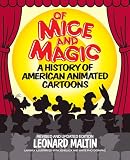
Leonard Maltin’s Of Mice and Magic remains the readable studio-by-studio map if you want the industrial history without a ranked listicle. A Platinum Collection disc is a way of putting Termite Terrace back in front of a feature, which is closer to the original contract than an autoplay clip without credits.
The souvenir is optical. Next time a short starts without a studio card, look for the cel dust, the held frame, the musician who is doing more than wallpaper. Classic cartoons were not born in a children’s block. They were born in a dark theater that had already paid for a ticket, and they still behave like it.